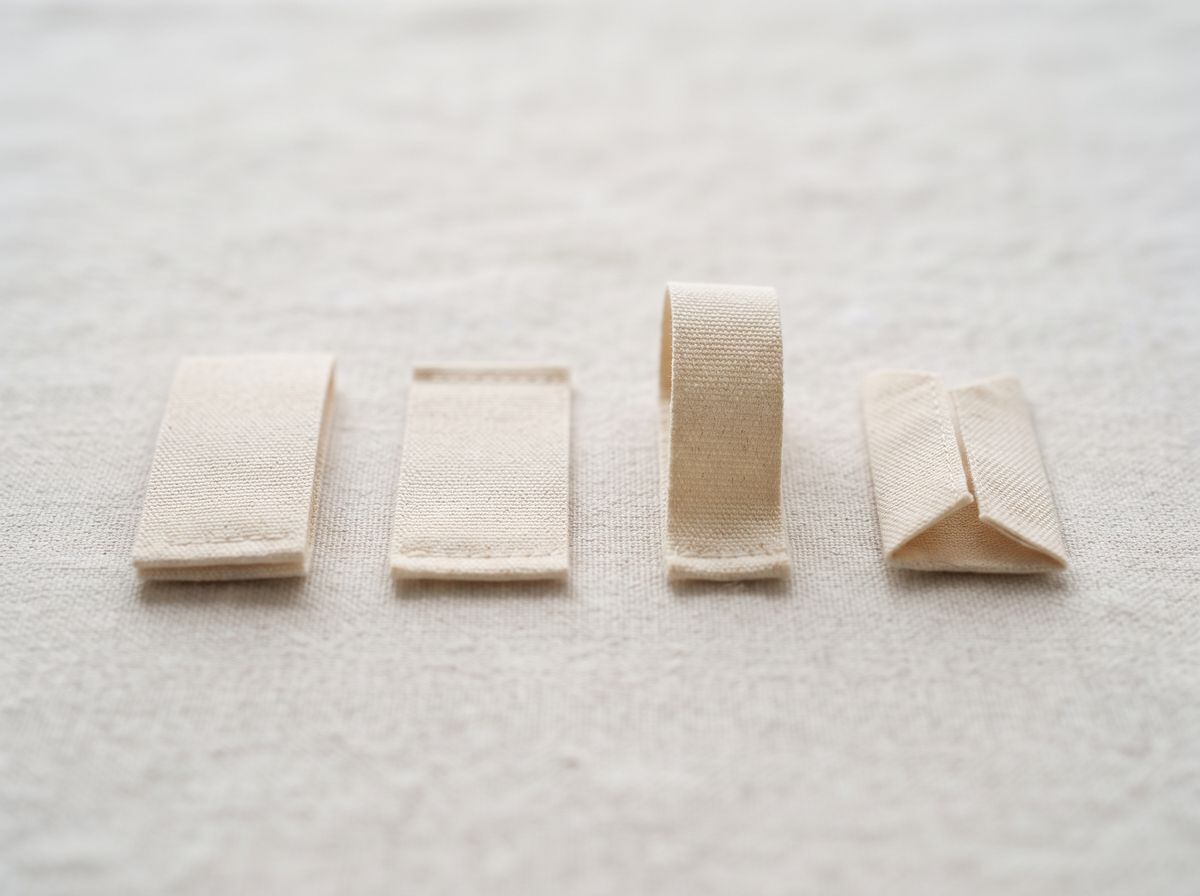
The fold types at a glance
A fold is how the ends of a label are finished before it is sewn. It decides three things: whether any cut edge can touch the skin, how the label is attached, and how much of the label the customer can see. The same woven or printed design can be made in any of these folds.
| Fold | What it looks like | How it is sewn | Typical use |
|---|---|---|---|
| Straight cut (flat) | A flat rectangle with cut edges | Stitched around all four sides | Outside branding on jackets, bags, blankets |
| End fold | Both short ends tucked under; flat face | Stitched across both folded ends, or all round | Back-neck brand label, inside waistbands |
| Centre fold | Folded in half; front and back faces | Both cut ends caught in a seam | Neck and side-seam labels, size and care labels |
| Loop fold | Ends folded back to meet; closed loop | Ends caught in a seam together | Hem tags, sleeve tabs, hanging loops |
| Mitre fold | Ends folded at an angle; a pointed tab | Ends caught in the neck seam | Hanging neck labels, statement labels |
| Book fold | Several panels folded together like pages | Caught in the side seam at one edge | Multi-language care and content labels |
Each fold in detail
Straight cut
The label is cut to size and left flat. Because all four edges are exposed, it is sewn around the full perimeter so the edges cannot curl or fray. Straight-cut labels are used where the label is meant to be seen from the outside: the chest of a workwear jacket, the flap of a backpack, the corner of a blanket or quilt. They are a poor choice inside a collar, because the stitched edges sit directly on the skin.
End fold
Both short ends are folded under, so the label shows a clean face with no cut edge at either side. It is usually sewn across the two folded ends, which leaves the long edges free, or stitched all the way round for extra security. The end fold is the classic back-neck label on shirts, knitwear and outerwear, and the usual choice for inside waistbands on trousers and skirts. It reads well because the whole face sits flat and visible.
Centre fold
The label is folded in half and both cut ends are sewn into a seam together. The result is a small flap with two faces. That makes it useful when you need more space without a bigger footprint: brand and size on the front, fibre content or country of origin on the back. Centre folds are common in neck seams of T-shirts and in side seams for size and care labels. When designing one, remember that the back face is printed or woven the other way up, so check the orientation on the proof.
Loop fold
Both ends are folded back to meet in the middle, and the joined ends go into the seam, forming a closed loop. Only the outer face shows. The loop fold is what most streetwear hem tags use, sewn into the side seam at the bottom hem or into a sleeve cuff. In a stronger, wider tape it also becomes a hanging loop for towels, robes and jackets.
Mitre fold
The ends are folded at an angle, usually around 45 degrees, so the label forms a pointed tab with the two ends side by side in the seam. Sewn into a neck seam, it hangs as a small V-shaped loop that can double as a hanger loop. Mitre folds look deliberate and are often chosen for statement neck labels on outerwear, tailoring and premium knitwear.
Book fold
Used for care and content labels that have to carry a lot of text, such as several languages. Multiple panels are folded together and caught in the side seam along one edge, so the customer can flip through them like a small booklet. Book folds are almost always printed on satin or nylon taffeta tape rather than woven. See our printed satin labels and care labels.
Which fold for which garment
| Garment or product | Brand label fold | Why |
|---|---|---|
| T-shirts and sweatshirts | Centre fold or end fold at the neck | Hides cut edges; small footprint |
| Shirts and knitwear | End fold | Flat, clean face that reads as a premium label |
| Outerwear and tailoring | Mitre fold or end fold | Mitre doubles as a hanging loop |
| Hoodies and streetwear | Loop fold hem tag, plus a neck label | Visible brand detail on the outside |
| Jeans and trousers | End fold inside the waistband | Lies flat against the waistband |
| Beanies and hats | Straight cut or end fold on the cuff | Sewn flat where it is seen |
| Blankets, quilts and bags | Straight cut or end fold | Sewn on all sides on a flat panel |
| Care and content labels | Centre fold or book fold in the side seam | Room for text; sits inside the seam |
For where each label sits on the garment, see our label placement guide.
Folded size vs flat size
The size you see on the finished garment is not the size of the label before folding. Each fold uses some of the length:
- End fold: each end loses a fold allowance, so the flat label is longer than the visible face. The allowance depends on the thickness of the label and the sewing method.
- Centre fold: the flat label is roughly twice the visible length, plus the part that disappears into the seam.
- Loop fold and mitre fold: part of the length goes into the seam, so the visible loop or tab is shorter than the flat tape.
Because these allowances vary by material and by how the garment factory sews, the simplest approach is to tell your supplier the finished size you want to see and the fold type, and let them calculate the flat size. A good proof shows both. If your garment factory has a specific seam allowance, include it.
| You specify | Example | The supplier works out |
|---|---|---|
| Finished size | 50 × 20 mm visible on the garment | Flat length including fold allowances |
| Fold type | End fold | How much length each end needs |
| Seam allowance (if caught in a seam) | About 1 cm, from your factory | How much extra goes into the seam |
| Orientation | Text reads left to right with the label hanging down | Which way the design faces on each panel |
Edges, materials and comfort
Folds hide the short ends of a label, but the long edges are still there. On woven polyester labels these edges are normally heat-cut, which seals them so they do not fray. For neck labels, ask for soft heat-cut edges, which are less scratchy. Ultrasonic cutting is another option for a smoother edge on some materials.
The material also changes how a fold behaves:
- Woven damask is dense and holds a crisp fold. All fold types work. See damask woven labels.
- Printed satin and cotton tape are thinner and softer, so they fold easily and suit centre folds, loop folds and book folds.
- Thick or stiff tapes can be hard to fold tightly and may stand up from the fabric; flat straight-cut or end-fold styles suit them better.
If comfort is the priority, for example on babywear or activewear, consider skipping the folded tag entirely and using a tagless heat transfer label.
How to specify a fold on your order
- Choose the fold type for each label (brand, size, care).
- Give the finished size you want visible on the garment, in millimetres.
- Say whether the label is sewn flat or caught in a seam, and the seam allowance if you know it.
- For centre folds and book folds, list what goes on each face or panel.
- Ask for soft edges on anything that touches skin.
- Check the proof: it should show the flat size, the fold lines and which way the text reads.
Our first label order checklist covers the rest of the specification, from colours to quantities.
Common mistakes
- Ordering the flat size by accident. If you give 50 mm meaning the visible face, say so, or the folded label will come out shorter than expected.
- Straight-cut labels inside collars. Four stitched edges against the neck are the fastest way to get your label cut out.
- Upside-down back faces. On a centre fold the back panel reads the other way up. Check it on the proof.
- Too much text on one face. Move care and fibre details to a centre-fold or book-fold label in the side seam rather than enlarging the neck label.
- Not telling the garment factory. Share the fold type and placement with whoever sews the labels, so they leave the right seam allowance.