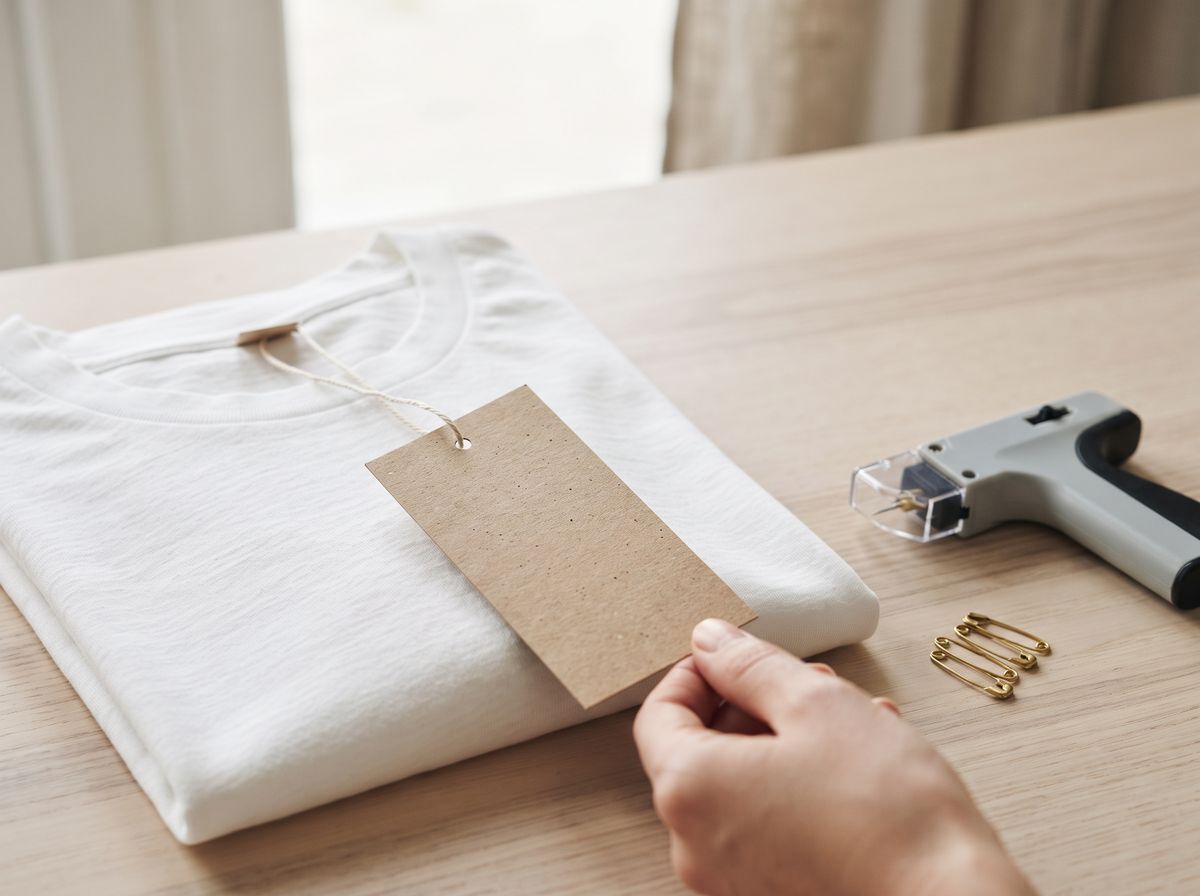
The six methods compared
How you attach a hang tag affects three things: how the product looks on the shelf, how fast your team or factory can tag a run, and whether the garment survives being tagged. There is no single right answer. Most brands pick one method for everyday stock and another for delicate pieces.
| Method | Speed | Look | Best for | Watch out for |
|---|---|---|---|---|
| Tagging gun + plastic fastener | Fastest | Functional | High-volume apparel, retail-ready stock | Needle holes in fine fabric |
| Pre-tied string loop | Medium | Clean, classic | Most clothing brands, gifts | Takes longer by hand at volume |
| Tied string or twine | Slow | Handmade, natural | Small batches, eco and craft brands | Inconsistent knots |
| Safety pin | Medium | Traditional, tailored | Knitwear, silk, delicates | Pins must be rust-free |
| Elastic loop | Fast by hand | Discreet | Buttons, hangers, boxed apparel | Can slip off loose items |
| Ribbon | Slow | Decorative, premium | Jewelry, beauty, gift sets | Too weak for heavy tags |
All the strings, pins and fasteners are available from our hang tag accessories range, from $12 per 1,000 for brass safety pins and $15 per 1,000 for strings.
String loops step by step
A pre-tied string loop gives the cleanest result and needs no tools. Most strings are supplied as closed loops, often around 20 cm long.
- Thread the tag. Push one end of the loop through the hole in the hang tag.
- Lock it. Pass the tag back through the loop and pull gently. The string now grips the tag with a lark’s head knot, with no loose ends.
- Attach to the garment. Push the free end of the loop through a buttonhole, under the neck label or through a belt loop.
- Lock it again. Pass the tag through the free end of the loop and pull snug. The tag now hangs from the garment without any knot to tie.
For a double tag, for example a brand tag and a separate price or barcode tag, thread both tags in step 1 with the brand tag in front. If you tie loose twine instead of using pre-tied loops, use a simple double knot and trim the ends to the same length on every piece so the batch looks consistent.
Using a tagging gun
A tagging gun pushes a hollow needle through the fabric and fires a small plastic fastener through it, with a T-shaped bar on each end. It is the standard in fashion retail because one person can tag hundreds of garments an hour.
- Choose the right type. Tagging guns and fasteners come in standard and fine versions. Fine needles leave smaller holes and suit shirts, dresses and lightweight fabrics; standard suits denim, outerwear and heavy knits. Fine fasteners and standard fasteners are not interchangeable, so buy them together.
- Load the fasteners. Slide the clip of fasteners into the gun until the first one sits in front of the needle.
- Put the tag on the needle first. Push the needle through the tag hole so the tag sits at the base of the needle.
- Pierce the right spot. Push the needle through the care label, the seam allowance, the label loop or a buttonhole, not through the open face of the garment.
- Fire and release. Squeeze the trigger fully, then pull the needle straight back out.
Fasteners come in several lengths. Short ones keep small items such as socks and jewelry tight; longer ones let the tag hang clear of a buttonhole or collar. Plastic seal tags that work with tag guns are available from $18 per 1,000.
Safety pins, elastics and ribbon
- Safety pins. Pass the pin through the tag hole and then through the care label or a seam allowance. Brass or coated pins avoid rust marks. This is the gentlest method for knitwear, silk and fine wool, because the pin pushes fibres aside instead of cutting them.
- Elastic loops. Loop through the tag like a string, then stretch over a button, a hanger hook or a zipper pull. They need no tools and customers can remove them without scissors, which suits gift packaging and boxed apparel.
- Ribbon. Thread through the tag hole and tie a bow around a strap, handle or neck of a bottle. Ribbon is decorative rather than strong, so keep it for light tags on jewelry, beauty and gift products. Heavy tags such as booklet tags need waxed cotton or polyester cord.
Where to attach on each garment
The aim is for the tag to be visible when the product hangs or lies folded, while touching the garment only at a point that hides any mark.
| Product | Attach through | Recommended method |
|---|---|---|
| T-shirts and sweatshirts | Back neck label or side-seam care label | Tag gun (fine) or string loop |
| Button-up shirts | Top buttonhole or neck label | String loop or tag gun through the label |
| Jeans and trousers | Belt loop, back patch or waistband label | String loop or standard tag gun |
| Dresses | Care label or zip pull | Fine tag gun through the label, or elastic |
| Knitwear and silk | Care label | Safety pin or string, never a standard needle |
| Jackets and outerwear | Zip pull, hanger loop or sleeve label | String loop or standard tag gun |
| Hats and caps | Inside sweatband label or back strap | Tag gun through the label, or string |
| Socks | Through the top of the pair, or use a header card | Short fastener or a sock header |
| Bags and accessories | Handle, strap or zip pull | String, elastic or ribbon |
Not sure where the sewn labels sit? Our label placement guide shows the usual positions. For socks, a sock header card usually replaces the hang tag altogether.
Avoiding damage to the garment
- Never pierce the open fabric of fine or tightly woven garments. Go through a label, seam allowance or buttonhole instead.
- Match the needle to the fabric. Use a fine gun on shirts, dresses and lightweight knits.
- Skip needles on delicates. Silk, satin, cashmere, leather and loose knits are safer with a safety pin through the care label, or a string through a buttonhole.
- Check the tag edge. Sharp corners on heavy board can scuff smooth fabrics in transit; rounded corners help.
- Think about removal. Customers cut fasteners and strings with scissors. Leave enough length that they can cut beside the garment rather than against it.
Tagging in production
Decide early who attaches the tags. If your garment factory tags the products, ship the tags to them with the attachment method, the position and a photo of one correctly tagged sample. If your warehouse or fulfilment partner does it, order the tags with strings or elastics already threaded through, so the only step left is attaching to the garment.
When you sell through retailers, check their vendor or routing guide before you tag. Many specify where the tag must hang, which fastener to use and where the barcode should face. Our price and barcode tags page covers barcode tags, and what to put on a hang tag covers the front and back layout.