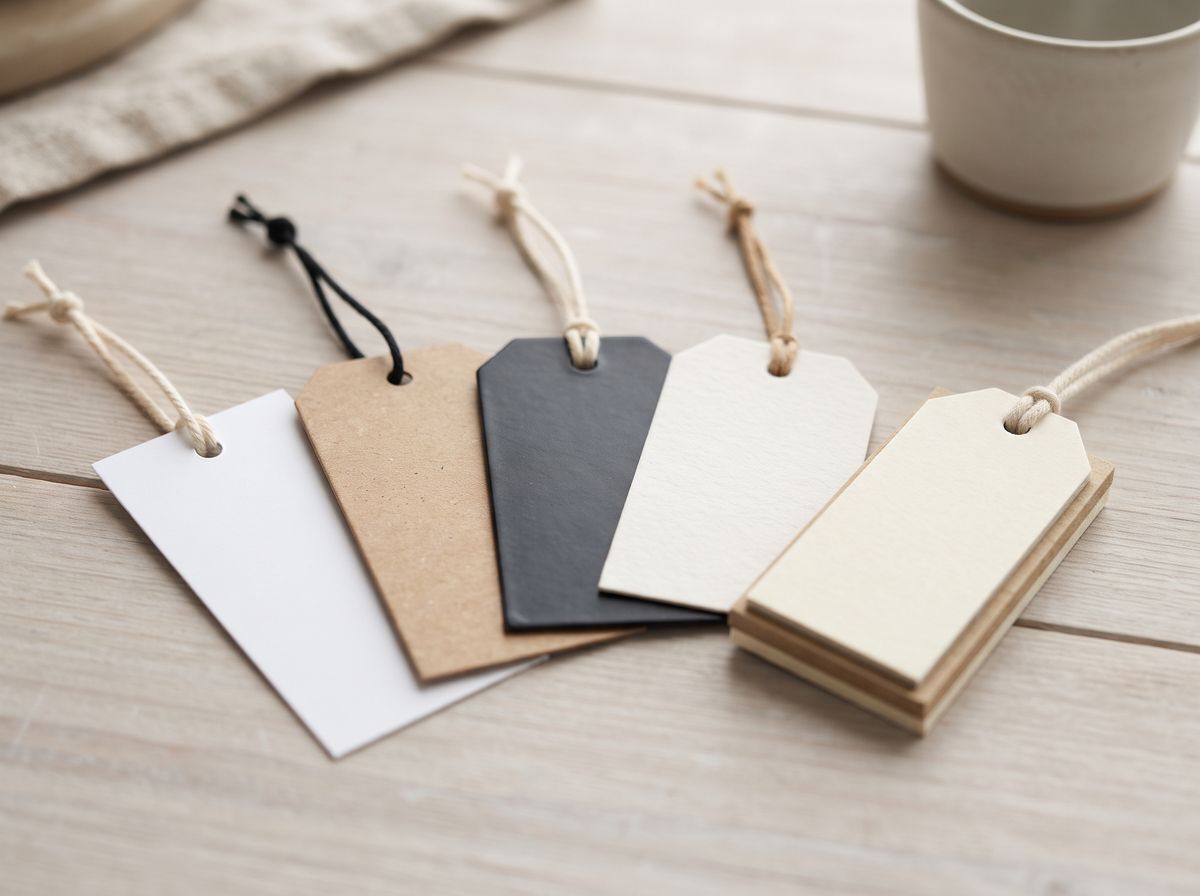
The main stocks at a glance
The paper is the first thing a customer notices when they pick up a tag, often before they read it. It decides how colours print, which finishes are possible, how the tag ages on the rail and whether it can go in the paper recycling. These are the stocks brands choose most often.
| Stock | Look and feel | Printing | Best for |
|---|---|---|---|
| Coated white card (C1S / C2S) | Smooth, bright, crisp | Sharpest colour and fine detail | Most apparel and retail tags |
| Uncoated white card | Soft, matte, natural | Slightly softer colour; easy to write on | Minimal brands, handwritten prices |
| Kraft card | Brown, fibrous, earthy | Black and white ink look best; colour is muted | Eco, handmade, food and candle brands |
| Black card | Dark, dramatic, premium | Foil, white ink or spot UV | Luxury, evening wear, streetwear |
| Textured and cotton papers | Linen, felt or cotton-rag surface | Good with simple artwork; textures soften fine lines | Bridal, artisan, premium knitwear |
| Layered board | Thick and rigid, often with a coloured core | Same as the face sheet | Premium tags that must feel substantial |
| Synthetic (PP, PVC, Tyvek-type) | Smooth, tear-resistant | Needs suitable inks | Swimwear, outdoor, plants, anything that gets wet |
GSM and thickness explained
GSM means grams per square metre. It is the weight of the paper, not its thickness, but within one type of stock a higher GSM almost always means a thicker, stiffer tag. Be careful when comparing across stocks: a 350gsm uncoated card can feel thicker than a 350gsm coated card, because the coating makes the sheet denser.
| Weight | How it feels | Typical use |
|---|---|---|
| Under 250gsm | Thin and bendy; can curl | Swing tickets on low-cost items, inserts, not ideal for apparel |
| 300gsm | Light but firm | Everyday kraft and small tags |
| 350gsm | Solid, hangs straight | The standard choice for clothing tags |
| 400–450gsm | Noticeably substantial | Premium tags and die-cut shapes |
| Layered board (two or more sheets) | Thick and rigid, like a card | Luxury tags, edge-painted tags, heavy die-cuts |
Thickness also changes the practical details. Very thick tags need a larger hole or an eyelet, a stronger string and sometimes a bigger tag size so the proportions look right. Our hang tag sizes guide covers standard dimensions and hole positions.
Each stock in detail
Coated white card
Coated card has a thin layer of clay or similar coating that seals the surface. Ink sits on top instead of soaking in, so photographs, gradients and small type stay sharp and colours stay bright. It is called C1S when coated on one side and C2S when coated on both. C2S is the usual choice when both sides of the tag are printed. Coated card is also the best base for lamination, which protects the tag from scuffs on the shop floor.
Uncoated white card
Uncoated card has a soft, slightly toothy surface. Colours print a little softer and darker because the paper absorbs some ink, but the tag feels more natural and less “printed”. It is also easy to write on with a pen, which suits brands that handwrite prices or sizes, and, left unlaminated, it is usually easier to recycle.
Kraft card
Kraft is unbleached brown card, often made with recycled fibre. It instantly signals natural, handmade or eco, which is why it is so common for candles, food, home goods and small-batch clothing. Black ink prints rich and crisp, and white ink or gold foil adds contrast. Full-colour artwork prints, but it takes on the brown of the paper, so bright brand colours look muted. See kraft hang tags and eco-friendly hang tags for options and prices.
Black card
Black card makes a tag feel premium straight away. Because you cannot print light colours onto it with ordinary process ink, the artwork is usually foil-stamped, printed in white ink, debossed or highlighted with spot UV. There are two kinds: board printed black on a white core, which shows a thin white line at the cut edge, and dyed-through black card, which is black all the way through. If the edges will be seen up close, ask for dyed-through.
Textured and cotton papers
Specialty papers have an embossed or naturally textured surface: linen, felt, laid lines or the soft surface of cotton-rag paper. They feel handmade and expensive, and suit simple artwork such as a logo with a little text. Very fine lines and small type can break up on a strong texture, so keep the design bold. Debossing and foil both look excellent on these stocks.
Layered board
For a tag that feels like a thick card, two or more sheets are laminated together. This lets you combine a printed face with a coloured core that shows at the edge, for example a white tag with a black or red middle layer. Layered boards take debossing very well because the extra thickness gives the impression room to sink in. They cost more and need a stronger string or an eyelet.
Synthetic stocks
Plastic and synthetic papers such as PP, PVC and Tyvek-type materials do not tear, crease or go soft in water. They are the right choice for swimwear, outdoor equipment, garden products and anything sold in humid or wet places. They are not paper, so they cannot go in the paper recycling and they suit a technical rather than natural look.
Which finishes suit which paper
| Finish | Coated card | Uncoated / kraft | Black card | Textured / cotton | Layered board |
|---|---|---|---|---|---|
| Full-colour print | Excellent | Softer / muted | Not suitable | Good on simple art | Excellent on coated face |
| Matte or gloss lamination | Excellent | Possible, loses the natural feel | Good (soft-touch is popular) | Not usual | Good |
| Foil stamping | Very good | Very good | Excellent | Very good | Very good |
| Debossing / embossing | Good | Very good | Good | Excellent | Excellent |
| White ink | Not needed | Good on kraft | Good | On dark colours | On dark faces |
| Spot UV | Very good on laminated card | Not usual | Very good | Not usual | Good |
On our hang tags, debossing (+$20) and custom die-cut shapes (+$30) are flat per-order add-ons, and foil on kraft is +$25 per order. Our hang tag pricing guide explains how stock and finishes add up.
Matching the stock to your brand
- Bright, colourful or photographic branding: coated white card, often laminated.
- Natural, organic or handmade: kraft or uncoated recycled card, no lamination, cotton or hemp string.
- Luxury and evening wear: dyed-through black card or a layered board with foil and deboss.
- Bridal, knitwear and artisan: cotton or textured papers with a single foil or deboss detail.
- Sports, swim and outdoor: synthetic stock or laminated card that survives water and handling.
- Kids and family: coated card with rounded corners; avoid very stiff sharp-cornered boards.
How to choose in five questions
- What does the artwork need? Full colour and fine detail point to coated card. A one-colour logo opens up kraft, black and textured stocks.
- How should it feel in the hand? Light and simple (300–350gsm), substantial (400–450gsm), or rigid (layered board).
- Where will it live? Dry rails and shelves suit any paper. Wet or outdoor settings need a synthetic or laminated stock.
- Does it need to be recyclable? Choose uncoated paper and skip lamination and large foil areas.
- What is the budget per tag? Standard card is the most economical; specialty papers and layered boards cost more per tag.
If two stocks seem equally right, order the sample pack and compare them in your hand next to the actual garment.
Common mistakes
- Choosing by GSM alone. Coated and uncoated stocks of the same GSM feel different. Ask for a physical sample.
- Full-colour photos on kraft. The brown base dulls them. Use white card or a single strong ink colour.
- Black card with fine white text. Small reversed type can fill in. Keep text bold and not too small.
- A thin tag on a heavy garment. A 250gsm tag on a wool coat looks cheap and bends. Scale the stock to the product.
- Forgetting the string. Thick or heavy tags need a stronger cord or an eyelet. See hang tag accessories.
- Laminating an eco tag. A plastic film undoes the recyclable message. Use deboss for a premium touch instead.
Ready to design the tag itself? See what to put on a hang tag for the front and back layout, then request a quote on our custom hang tags page.