Your logo made in thermoplastic polyurethane and bonded to the garment with heat, so there are no stitches and no needle holes. Flat or raised, glossy, matte or metallic. Custom quote, free proof.
Quick answer: TPU labels are logo badges cut or moulded from thermoplastic polyurethane film with a heat-activated adhesive on the back. They are heat-pressed onto the outside of a garment, so there is nothing to sew. Brands use them for chest and sleeve logos on sportswear, waistband marks on leggings and stitch-free branding on waterproof jackets and bags. Every TPU order is quoted to your design, with a free proof.
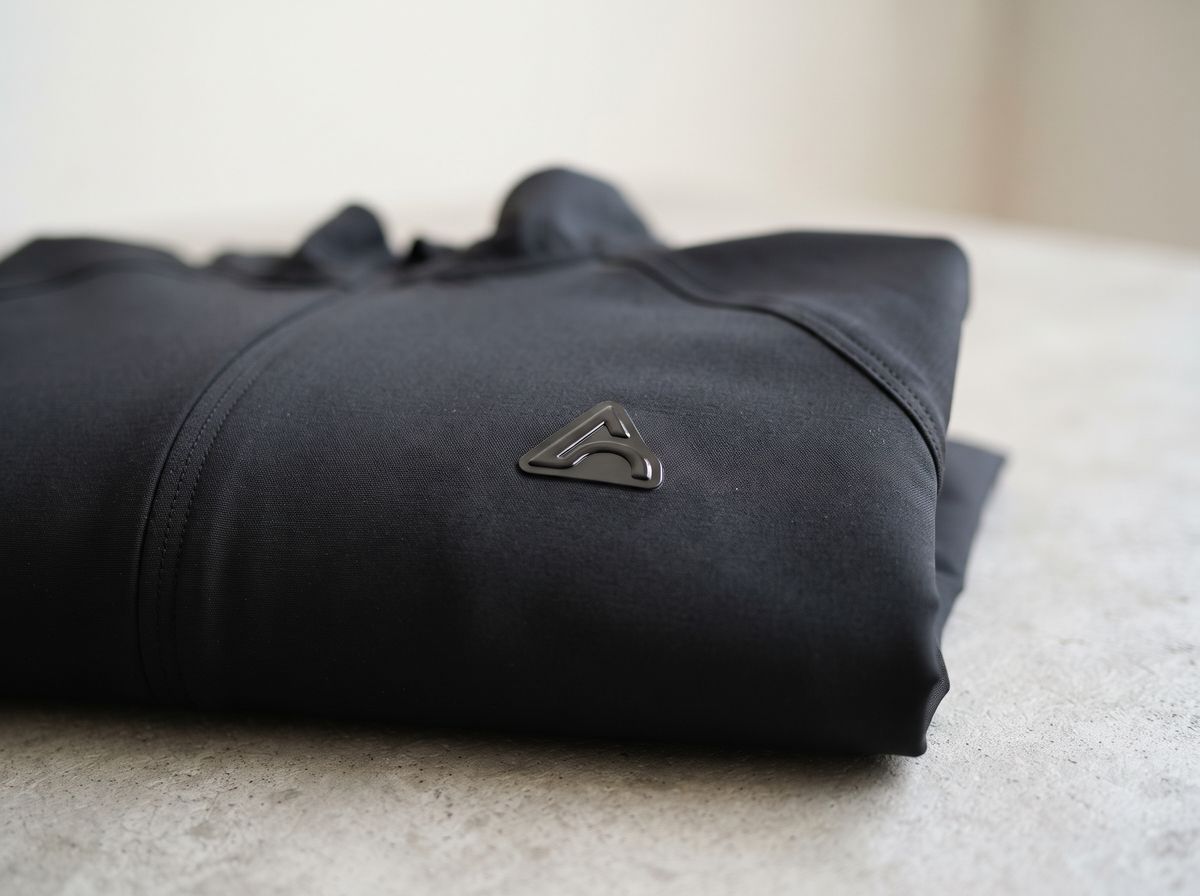
A TPU label is a logo or brand mark made from thermoplastic polyurethane and attached to a garment with heat rather than thread. The badge is built up from TPU film, printed or coloured, then cut to the outline of your logo. For a raised, three-dimensional look, the film is pressed into a mould so the logo stands up from its base. A hot-melt adhesive layer on the back bonds to the fabric when the label is pressed with a heat press.
The result sits on the outside of the product as a crisp, slightly glossy or matte badge. You will see this style on running jackets, cycling jerseys, gym shorts, leggings waistbands, ski wear, caps, backpacks and soft cases. It reads as modern and technical, which is why it is popular with sportswear and outdoor brands rather than with heritage or handmade labels.
Because nothing is stitched, a TPU label adds no needle holes. That matters on lightweight performance fabrics that pucker under a sewing line, and on waterproof shells where every stitch is a potential leak point that would otherwise need seam tape.
| TPU label | Silicone heat transfer | Tagless printed transfer | Woven label | |
|---|---|---|---|---|
| Typical use | Outside logo badge | Outside raised logo or grip print | Inside neck or waistband print | Inside neck label or outside tab |
| Feel | Thin, smooth, slightly firm | Soft, rubbery, raised | Almost nothing to feel | Textile, edges you can feel |
| Finishes | Glossy, matte, metallic, mirror-like | Mostly matte, some gloss | Flat ink | Thread colours and weave texture |
| 3D effect | Yes, with a mould | Yes, built up in layers | No | Slight, from the weave |
| Fine detail | Crisp outlines; tiny gaps can fill in on raised designs | Good on bold shapes | Good at readable sizes | Very good on damask |
| Attachment | Heat press | Heat press | Heat press | Sewing |
| Price on our site | Custom quote | from $109 / 250 (activewear range) | 250 from $95 | 250 from $89 |
Prices shown are the published starting prices for those products on our site. TPU depends heavily on size and finish, so it is always quoted to your artwork.
TPU is less suitable for very heat-sensitive fabrics, deep-pile textures such as fleece with a long nap, and areas that bend sharply over seams, zips or pockets, because the press plate cannot sit flat there. If you want the label inside the garment for size and care, a tagless heat transfer is normally the better fit.
| Option | What it looks like | Good to know |
|---|---|---|
| Flat TPU badge | A thin cut-out logo, one or several colours | The simplest and most flexible style; no mould needed |
| 3D raised TPU | The logo stands up from the base in relief | Needs a mould made from your artwork, quoted once per design |
| Glossy or matte surface | Shiny, wet look or a soft, low-sheen face | Matte hides scuffs; gloss reads as sporty |
| Metallic and mirror effects | Silver, gunmetal or gold tones | Popular for minimal one-colour logos |
| Contour cut | The badge follows the outline of the logo | Very thin points and hairlines are fragile; we may thicken them |
| Badge on a base shape | Logo sits on a rectangle, circle or shield | Easiest to press neatly and keeps small letters together |
Not sure which finish suits your logo? Send the artwork and the garment colour, and we suggest one or two options on the free proof.
Vector artwork (AI, PDF or SVG) is best. Our artwork preparation guide explains how to set up files.
TPU labels are applied at the garment factory or in your own workshop with a heat press. The right temperature, dwell time and pressure depend on the transfer and on the fabric, so we give you recommended settings for your specific label with the proof. The general process is the same for every order:
Always press a few test garments and run them through several washes before committing a full batch. That catches the two most common problems, under-pressing and a fabric finish that resists the adhesive, while they are still cheap to fix. For the inside of the same garments, our printed care labels carry the fibre content and washing instructions.
Logo file, rough size, colours, finish and the fabric you are pressing onto.
Exact price and a to-scale proof, usually within 24 hours. 3D designs show the mould layout.
Labels made, checked and packed on carriers, ready for the heat press.
DHL or FedEx with tracking, together with any other labels and tags in the same order.
| What changes the price | Why |
|---|---|
| Size of the badge | More material and a larger press area |
| Flat or 3D raised | 3D designs need a mould made once per design |
| Number of colours and finish | Each colour and metallic or mirror effect is an extra layer |
| Quantity per design | Set-up is shared across the run, so the unit price falls as quantity rises |
TPU labels are custom quote, free proof. Tell us the size, colours, finish and quantity and we confirm your exact price within 24 hours. DHL/FedEx shipping is quoted separately at cost.
TPU is thermoplastic polyurethane, a flexible plastic that softens with heat. In labelling it is used as a thin film or a moulded badge with a hot-melt adhesive on the back, so the label can be bonded to fabric with a heat press instead of being sewn on.
No. Both are heat-applied, but TPU is a thinner, firmer film that holds crisp edges, fine outlines and metallic or mirror finishes. Silicone transfers are softer and more rubbery, and are usually chosen for a raised, matte, grippy feel. They suit different looks rather than one being better.
When it is pressed at the right temperature, time and pressure for the fabric, a TPU label is made to stay on through normal home washing. Most failures come from under-pressing, pressing over a seam or a zip, or washing too soon. Press and wash-test a few samples before the full run.
Often, yes, which is one of the main reasons brands use them: a heat-bonded badge adds no needle holes to a waterproof shell. Some face fabrics have water-repellent or coated finishes that resist adhesives, so send us the fabric details and test a few pieces before production.
It is possible, but it is not the usual choice. TPU is mainly used for visible outside branding. For size and care details inside the neck, a tagless heat transfer is thinner and easier to read. Care information must stay legible for the life of the garment, so test any option you choose.
TPU labels are quoted per design, because size, thickness, colour count, finish and whether the badge is moulded all change the price. Send your artwork and quantity and we reply with an exact quote and a free proof, usually within 24 hours.
Related: Activewear labels · Outdoor gear labels · Tagless heat transfer labels · Iron-on labels
Exact price within 24 hours. No obligation. Your email is never published or shared.
Prefer email? Write to yuan36984@gmail.com with your company name and specs.
Send your specs now — quote in your inbox within 24 hours.